
ALL, Thermal, Thermal Scopes
Nocpix ACE H50R Vs S60R Review
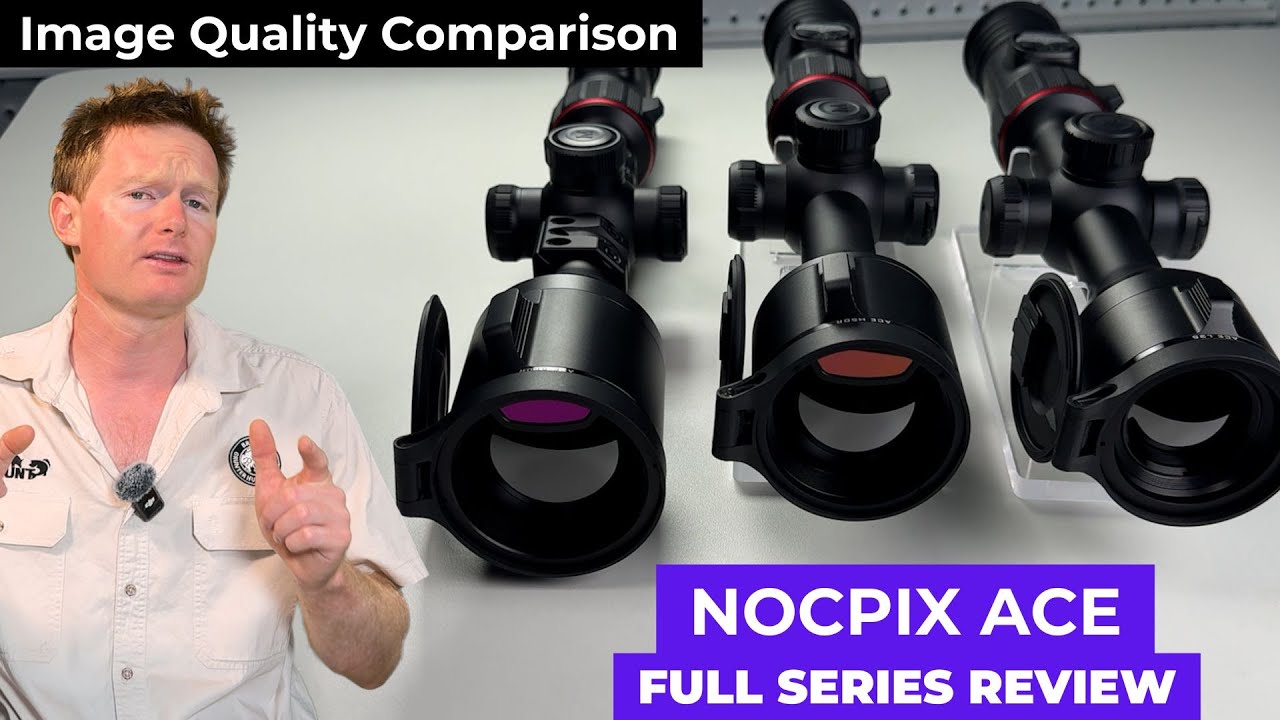
The full video review, 10 minutes — or read it below. Watch on YouTube to comment or subscribe.
Full review · Thermal scopes
Nocpix ACE Review
The original ACE series: S60R, H50R and L35 tested side by side
What makes the ACE series stand out
Are the Nocpix ACE series thermals all they are cracked up to be? Does the 1280 pixel S60R take thermals to an entirely new level? We are diving into all three models, breaking down their strengths and trade-offs, and taking an in-depth look at image quality, to give you the details you need to make an informed decision. Before we get into the image quality, though, let us talk about what makes the ACE series stand out.
Sensors and rangefinder
The high-end 640 pixel and 1280 pixel models feature a 15 millikelvin sensor and a built-in 1,200 metre rangefinder, delivering top-tier performance. Meanwhile, the 384 pixel model comes with an 18 millikelvin sensor but, when we filmed this, it did not have a rangefinder option.
Quick-release battery and ocular zoom
The ACE series brings some impressive innovations, including a quick-release battery system. Just press and the battery pops right out. The data and charge port is just a twist away, making access effortless. Plus, the newly introduced ocular zoom enhances the internal display, bringing you closer to your target faster and more conveniently.
Display and shutterless image
Every model features a massive one-inch round display with a sharp 2560 pixel resolution and a smooth 50 to 60 hertz refresh rate (the refresh rate is how many times a second the picture updates), delivering an incredibly fluid and immersive viewing experience. Thanks to the new shutterless technology, image freezes at critical moments are a thing of the past, keeping your view crisp and uninterrupted all night long.
For content creators
With freeze-frame zeroing, ballistic calculations and recoil-activated recording that ensures you never miss a moment, the ACEs are a powerful tool for content creators. Add to that a built-in microphone that delivers surprisingly clear audio, and it is easy to see why the ACEs are well regarded.
Those are some of the standout features, but every product has its pros and cons, and we cover those below. For the latest insights, give us a call.
How we tested
Our well-cared-for dogs helped us demonstrate image quality at various distances, ranging from 10 metres to 300 metres. This gives you a clear indication of field of view and detail retention at different ranges.
As always, the temperature and humidity are displayed on screen in the video, providing context for the conditions the recordings were made in. This is a crucial factor, as colder, more favourable temperatures can sometimes make one thermal appear better than another. We tested these devices in challenging conditions, pushing the sensors to their limits and showing real-world performance in harsh climates.
On the recordings: this review was filmed on the original ACE series and went up on YouTube in March 2025, before the ACE 2 was released. For the ACE 2 H50R and S60R tested against these models, see our Nocpix ACE 2 review.
Image quality: ACE H50R vs ACE S60R
The H50R
The H50R is a great all-rounder for close and long range. This would be the best value-for-money tool for those who want versatility. It has a great field of view for close range and awesome clarity for longer distances, achieving good accuracy out to 200 to 300 metres depending on the target, all within reason and depending on your skill level.
The S60R
Now, the S60R is the king for those with the coin. When we filmed this, it was one of the very few that sat as top picks on the market. The clarity is amazing and the field of view is perfect for close and long distances. The sky is the limit with this bad boy, so if you want the absolute best image quality with maximum range and identification, as well as outstanding accuracy even beyond the 300 metre mark, this might just be the thermal for you.
The market is forever changing, month to month. We highly recommend giving the team a call if you want the latest up-to-date intel and advice for your specific use case. We can certainly help you make an informed decision.
At 200 m
Out at the 200 metre mark, both models do an exceptional job, with the obvious winner being the S60R, but the H50R is certainly still holding its own.
At 300 m
The real test is when we move out to the 300 metre mark. This is where most thermals struggle, particularly under digital zoom. Nocpix’s image algorithms are quite good, and they are only going to get better. Look at the image quality on the S60R at 300 metres. The way it holds the shape of our dog at this distance is certainly some of the best clarity I have seen, capable of some exceptional results.
The trade-offs: battery life and weight
Though the ACEs offer many positives, there are a few negatives to consider.
Battery life
For instance, the battery life is not fantastic. Our drawdown test showed that the H50R lasted a total of 6.5 hours, with about 3.5 hours from the removable battery using a 3600 Nitecore battery, and the S60R lasted around 5.5 hours overall, with roughly 2.5 hours from the removable battery.
They do use common 18650 batteries, so that is not a huge issue for most people, plus it is really quick and easy to pop that removable battery out.
Weight
Another factor to consider is the weight. With the ACE S60R weighing 1,300 grams and the H50R at 1,150 grams, they are quite heavy. There are other key points to consider as well, so for the latest intel it is best to give us a call.
Image quality: ACE H50R vs ACE L35
Do you really need a 640 pixel scope, or will a 384 get the job done? Let us find out by comparing the H50R to the L35. There are always pros and cons going one way or the other, and there are a lot of spec combinations that produce different results, so we will just cover the basics here. Our guide on how to choose a thermal scope goes further.
Base magnification and field of view
A high base magnification (the zoom the scope starts at before any digital zoom) in a 384 can produce quite good image quality at a distance, but at the expense of field of view. A 640 with a lower base mag can give you a better field of view for closer distances while still giving you good long-range potential, making them better all-rounders. So how much you need to spend tends to hinge on what you want to do with it.
Who each one suits
Someone who needs quick target acquisition and tracking of moving animals at closer ranges, while wanting good clarity at distance, would be better off with an ACE H50R or S60R.
On the other hand, someone on a budget wanting good clarity at close range and decent clarity at long range, who mainly shoots stationary targets or slow-moving foxes, would get by with the L35, as long as they accept that closer targets will take longer to find in the view and are easier to lose track of, due to the higher base mag. So there are certainly trade-offs in the cheaper end of the market, but for the right use case, scopes like the L35 can get the job done for a lot of people.
Now, the L35 does have a base mag of 4, which is not super high. There are some on the market that have a 6 times base mag in the 384, so it is still a reasonably sensible base mag for close to mid-range targets.
At 300 m
As we move out to the 300 metre mark, you can see the L35 is still holding some of the shape of the animal, though not quite as well as the H50R. We got a lot of blocking and not a huge amount of refinement on the shape of the animal, though the H50R is also struggling at this distance.
I hope this helps you decide which end of the market you need to be focusing on. If you are still unsure, give us a bell and we will definitely help you out.
How conditions change the image
Now let us look at how conditions can affect your image quality, using a split screen in the video.
Early morning, dry
On the left, we were out in the early hours of the morning before daylight. It was dry as a chip, the temperature was lower and the terrain had had all night to cool down.
Evening, after rain
On the right-hand side, we were out at 8:30 pm. It had rained earlier in the day, and the temperature was slightly higher, but not a massive difference. However, the images looked noticeably different.
With some setting adjustments, either of them could be improved to your liking, but this is simply to show that the current weather conditions, the weather earlier in the day, and whether you go out early in the night or early in the morning can all have an effect on your image.
Rangefinder, ballistics and reticles
Rangefinder and ballistics
The rangefinder works just fine. It is very responsive and accurate, and the ballistics calculations are quite good and getting better with every update as well.
Picture-in-picture
Just like many other thermals on the market, the ACEs have a picture-in-picture mode, and it works just fine.
Reticles and settings
The ACE has many different reticle options as well, including custom reticles, and plenty of settings to play with.
Colour palettes, and how thermals work
The video runs through the different colour palettes here, so it is a good moment to cover how thermals work.
In simple terms, thermal devices measure differences in temperature, allowing you to identify terrain, objects and animals based on the infrared radiation they emit, which, believe it or not, everything on Earth emits. The greater the temperature difference, or the greater the contrast between them, the clearer the image and the easier the identification. This is why weather conditions can significantly impact performance.
Spec snapshot
| ACE S60R | ACE H50R | ACE L35 | |
|---|---|---|---|
| Sensor | 1280 × 1024 | 640 × 512 | 384 × 288 |
| Thermal sensitivity | 15 mK | 15 mK | 18 mK |
| Objective lens | 60 mm | 50 mm | 35 mm |
| Base magnification | 2× | 3× | 4× |
| Rangefinder | Built in, 1,200 m | Built in, 1,200 m | None when filmed |
| Display | One-inch round, 2560 pixel resolution, 50 to 60 Hz | ||
| Removable battery | 18650, quick release | ||
| Runtime, measured | about 5.5 h (about 2.5 h from the removable) | about 6.5 h (about 3.5 h from the removable) | Not tested in this review |
| Weight | 1,300 g [?] | 1,150 g [?] | Not stated [?] |
Which one is right for you?
How much you need to spend tends to hinge on what you want to do with it. Here is how each ACE came out in our testing.
ACE S60R
The S60R is the king for those with the coin. The clarity is amazing, the field of view is perfect for close and long distances, it was the obvious winner at 200 metres, and at 300 metres the way it holds the shape of our dog is some of the best clarity I have seen. If you want the absolute best image quality with maximum range and identification, as well as outstanding accuracy even beyond the 300 metre mark, this might just be the thermal for you. Keep in mind it weighs 1,300 grams and ran around 5.5 hours in our drawdown test.
ACE H50R
The H50R is a great all-rounder for close and long range, and it would be the best value-for-money tool for those who want versatility. It has a great field of view for close range and awesome clarity for longer distances, achieving good accuracy out to 200 to 300 metres depending on the target and your skill level. At 200 metres it was still holding its own against the S60R, though by 300 metres it is struggling.
ACE L35
For someone on a budget wanting good clarity at close range and decent clarity at long range, who mainly shoots stationary targets or slow-moving foxes, the L35 can get the job done, as long as you accept that closer targets will take longer to find and are easier to lose track of. Its base mag of 4 is still reasonably sensible for close to mid-range targets, and at 300 metres it is still holding some of the shape of the animal, though not as well as the H50R.
| If you… | Look at |
|---|---|
| Want the absolute best image quality, with maximum range and identification and accuracy beyond 300 m | ACE S60R |
| Want versatility, a great all-rounder for close and long range | ACE H50R |
| Need quick target acquisition and tracking of moving animals up close, with good clarity at distance | ACE H50R or ACE S60R |
| Are on a budget and mainly shoot stationary targets or slow-moving foxes | ACE L35 |
If you are still weighing up sensor and lens size, our guide on how to choose a thermal scope walks through it. Nocpix has since released the ACE 2, and our ACE 2 review puts the ACE 2 H50R and S60R up against these models.
Why we do these
What Bristle Up stands for
We put a huge amount of time into doing proper in-depth reviews across all the major brands, as well as the new and upcoming ones. It is not about trying to sell you whatever happens to be sitting on the shelf. It is about giving you the best advice we can, understanding what you actually need the device to do, and helping you get the right product and the best value for money.
That means brutally honest advice, getting your gear to you quickly, usually within two to four days across Australia, and backing you up after the sale. If you are unlucky enough to have warranty issues and you need your thermal for an upcoming trip or for work, we provide loan units to get you out of trouble.
We have built an awesome little team in Yuleba in Queensland, and something I am particularly proud of is that Bristle Up is creating real jobs in a rural town. When you support us, you are helping support country jobs and the families behind our team as well.
Shop the Nocpix ACE range
Prices and stock are on the product pages. If you are stuck between two models, call the team and tell us what country you hunt and how far you shoot.
Still deciding?
Talk it through with us
Tell us the country you hunt, the rifle it is going on and how far you realistically shoot, and we will tell you straight which ACE fits.